
Few stages of setting up a planted tank are as engaging as hardscaping. Handling stones, turning them over to inspect their texture, and visualizing where mosses or stem plants will settle feels like bringing a quiet stream bed indoors.
It is easy to assume that because a stone was found in a creek or purchased from a landscaping supplier, it is ready for an aquarium. But water in an enclosed glass box behaves very differently than an open, flowing river. In a closed volume of just five or ten gallons, the minerals resting inside a single decorative rock can quietly alter your water chemistry over weeks and months.
Determining whether a stone is chemically safe and "inert" does not require complex lab equipment. It comes down to fundamental water chemistry and a simple test using household white vinegar.
Why Rock Chemistry Matters: The Silent Shift in pH, KH, and GH
In aquascaping, an inert rock is one that does not react chemically with water or dissolve over time. It remains neutral, leaving your baseline parameters untouched.
Non-inert rocks, however, frequently contain deposits of calcium carbonate (CaCO3) or magnesium carbonate. In geology, these are common in sedimentary and metamorphic stones such as limestone, marble, tufa, and certain fieldstones.
When submerged, water gradually dissolves these carbonates, releasing calcium, magnesium, and bicarbonate ions into the water column. In an aquarium, this causes three interconnected shifts:
- Carbonate Hardness (KH) Rises: Carbonate ions buffer the water against acidity.
- pH Rises: As KH increases, the natural buffering capacity pulls your pH upward, often stabilizing well above 7.8 to 8.2.
- General Hardness (GH) Rises: The steady release of dissolved calcium (Ca2+) elevates total mineral hardness.
For African cichlid setups or certain hard-water species, this natural mineral release is beneficial. But for planted setups and delicate invertebrates, sudden or persistent mineral creep creates long-term instability. In a natural Neocaridina shrimp tank, unmonitored hardness directly interferes with the molting process, as explored in Shrimp Molting 101: Why They Fail & How to Prevent It.
When you regularly track your parameters using our AquaLog Water Tracker & Calculator, discovering a random carbonate-leaching stone explains why your weekly water changes feel like a continuous uphill battle against rising TDS.
How the Acid Test Works: The Chemistry of the Fizz
The vinegar test is an accessible version of the acid test that field geologists use to identify carbonate minerals.
Standard household white vinegar is a dilute solution (around 5%) of acetic acid (CH3COOH). When this mild acid contacts calcium carbonate, an immediate chemical reaction occurs:
CaCO3 + 2CH3COOH → Ca(CH3COO)2 + H2O + CO2 ↑
The acid breaks down the carbonate compound, producing water, soluble calcium acetate, and carbon dioxide gas.
Those escaping gas bubbles are the indicator. If a rock fizzes, foams, or forms tiny effervescent bubbles where the acid touches it, carbonates are actively dissolving. If the droplet rests clear and still on the surface, the rock is inert.
Step-by-Step: Testing Stones Before They Enter the Tank
Testing hardscape takes only a minute and requires just a bottle of white vinegar, an eyedropper or spoon, and a towel.
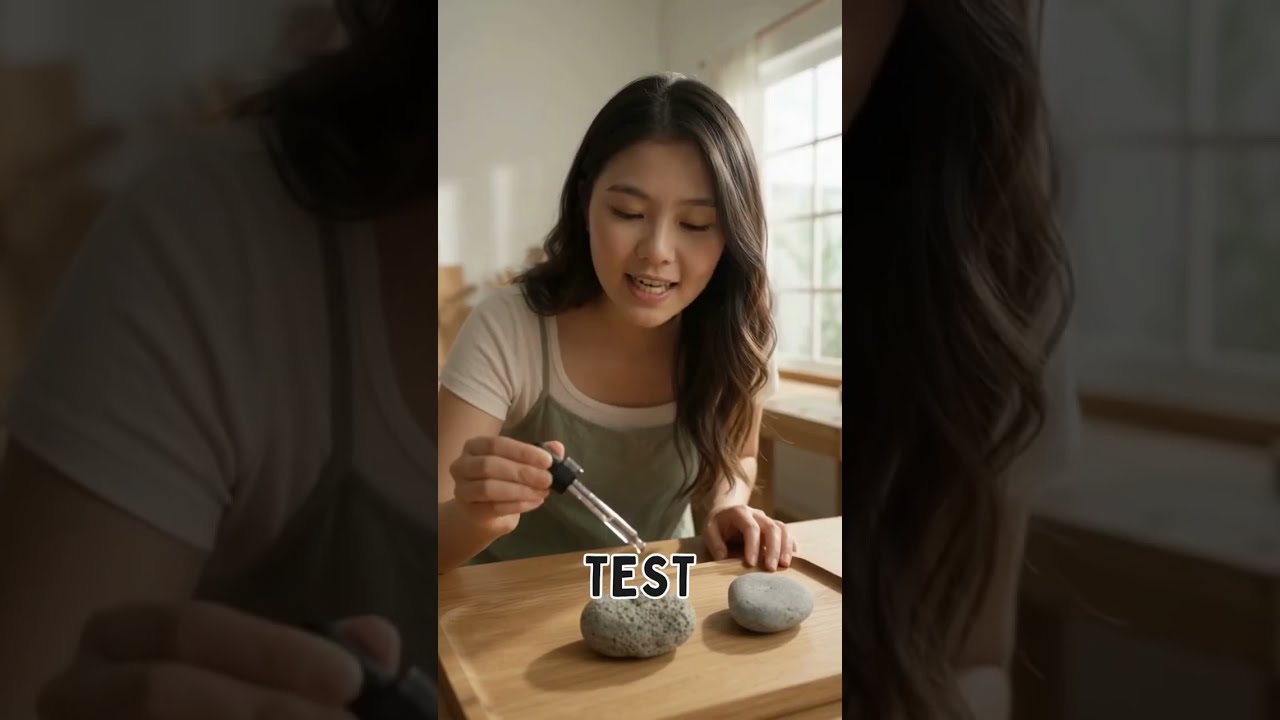
1. Clean and Dry the Stone Thoroughly
Scrub away loose soil, dust, or organic debris with a stiff brush and tap water. Avoid household detergents or soaps entirely. Allow the rock to dry completely; residual surface water can dilute the mild acid or trap air pockets that look like false bubbles.
2. Expose Fresh Mineral Surface
Outdoor stones often have weathered outer skins or coatings of inert river silt. Use a small file or the edge of a clean butter knife to scratch an inconspicuous spot on the rock, exposing the unweathered grain beneath.
3. Apply 3 to 4 Drops of Vinegar
Drip household white vinegar directly onto the scratched area.
4. Observe the Reaction Closely
Inspect the contact point under good lighting:
- Inert (Tank-Safe): The vinegar sits flat and clear, resembling a drop of plain tap water. There is no hissing sound and no micro-bubbles forming at the base. The stone will not alter pH or KH.
- Reactive (Carbonate-Bearing): You see immediate foaming, frothing, or a steady stream of tiny bubbles rising through the liquid. Carbonates are present, meaning the rock will actively harden aquarium water.
A Practical Field Note: Because household vinegar contains only 5% acetic acid, stones with faint or tightly bound calcite veins (such as Seiryu stone) may produce an extremely subtle reaction. If you see no immediate fizz but suspect the stone contains minerals, hold the rock close to your ear to listen for a faint crackle. For a stronger test on ambiguous specimens, aquarists often use API Nitrate Test Solution #1 (which contains dilute hydrochloric acid) or standard aquarium pH Down.
A Grounded Practice
When I first started collecting smooth field stones for low-tech tanks, I found a dark grey river rock marked with fine, pale white streaks. Visually, it complemented dark moss and wood textures perfectly. But over the following month, water tests consistently showed an unexpected rise: the tank’s KH drifted upward by three degrees, pulling the pH higher despite steady routine maintenance. Testing the rock afterward took less than a minute—a single drop of vinegar sizzled quietly right along those white mineral veins. Removing it and doing two gradual water changes brought the chemistry back into balance. Taking five seconds to verify hardscape on the table prevents weeks of troubleshooting an established setup.
Common Aquascaping Stones: Quick Reference
Before collecting or ordering hardscape, this reference covers how common stone varieties interact with freshwater:
| Stone Variety | Inert? | Water Parameter Influence | Best Suited For |
|---|---|---|---|
| Lava Rock (Basalt / Scoria) | Yes | Completely neutral; highly porous structure hosts beneficial nitrifying bacteria. | Low-tech planted tanks, shrimp colonies, and core base-building. |
| Dragon Stone (Ohko) | Yes | Chemically inert hardened clay; does not alter pH or hardness. | Planted scapes, root-heavy setups (rinse clay dust before use). |
| Slate | Yes | Metamorphic and generally inert; stable flat layering. | Terracing, cave structures, minimalist layouts. |
| River Pebbles / Granite | Yes (mostly) | Quartz- and silica-based stones are chemically non-reactive. | Natural riverbed biotope setups and gentle accents. |
| Seiryu / Ryuoh Stone | No | Rich in calcite veins; steadily releases calcium, elevating GH, KH, and pH. | High-energy tanks with pressurized CO2 or adaptable tap-water setups. |
| Limestone / Holey Rock | No | Strongly reactive; rapidly buffers water into high pH ranges. | African rift lake cichlids, brackish tanks, and hard-water livebearers. |
Using a non-inert stone like Seiryu is not an error if your livestock prefers harder water. However, it requires deliberate management. If you choose reactive stones, use our Aquarium Volume & Water Change Calculator to plan consistent dilution schedules and maintain stable water parameters.
Observation as a Habit
Aquascaping thrives on patience and observation. Checking your materials beforehand avoids the disruptive process of pulling hardscape out of rooted plants and established substrate later on.
A five-second check with everyday vinegar provides clarity on what is entering your closed ecosystem, keeping the water balanced and your livestock healthy.
Internal Guides & Practical Reading
- AquaLog Water Tracker & Calculator – Record and monitor your GH, KH, and pH stability week over week.
- Why I Started Logging GH, KH, TDS, and pH – How tracking these four measurements simplifies planted aquarium care.
- GH, KH, and TDS: Three Water Numbers That Tell a Story – A simple guide to understanding dissolved mineral content.
- Aquarium Volume & Water Change Calculator – Calculate net water volume and plan gentle water changes.


No comments:
Post a Comment